


 Price:

Record pungency-related handling conditions before the run
Document grind size, apparent density, moisture, oil content, clumping tendency and the room conditions used for the trial. Also record the operator controls selected for dust exposure, product loading and cleanup. This page does not claim a workplace exposure limit; the buyer should apply its own risk assessment and local requirements to extraction, protective equipment and cleaning.
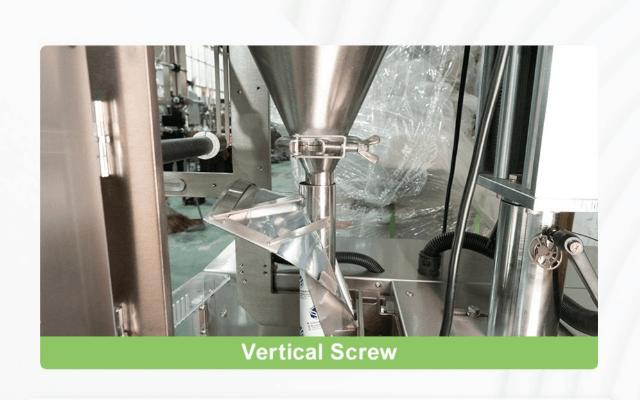
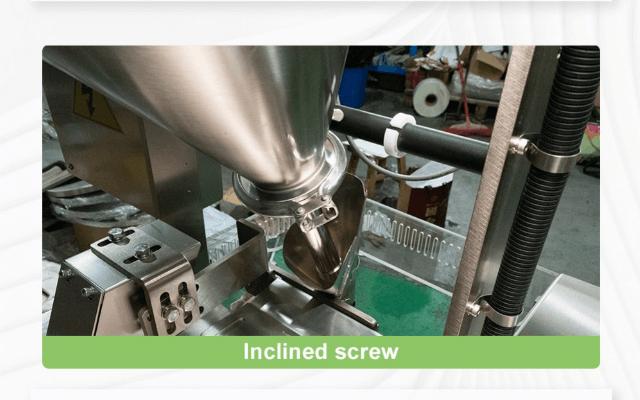
Vertical and inclined screw arrangements solve different feed problems
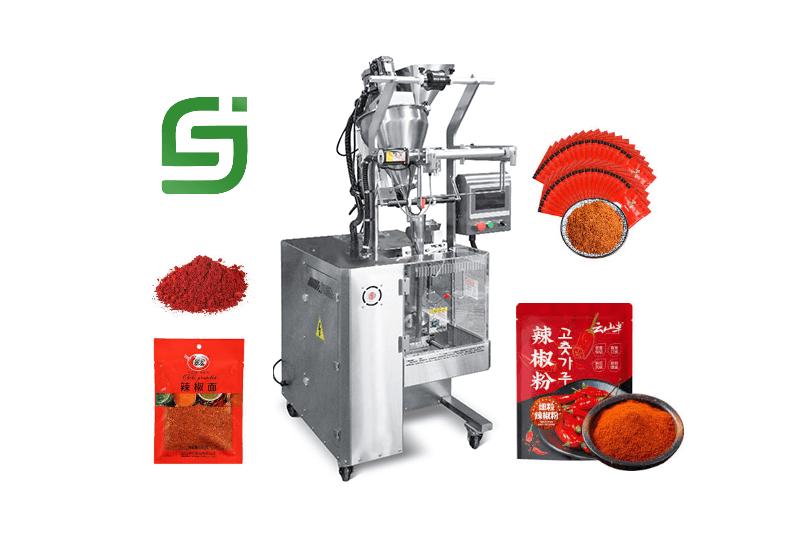
The saved machine imagery includes both vertical and inclined screw details. They should be treated as configuration evidence, not as a promise that both are supplied. Compare how the selected screw fills, cuts off and clears the actual powder. Fine dry chili may fluidize, while a slightly oily grade may coat flights and change delivery after a pause.
| Trial condition | What to observe | Decision supported |
|---|---|---|
| Freshly conditioned powder | Initial flow, dose spread and dust escape | Baseline screw speed and cutoff |
| Powder after room exposure | Clumps, bridging and surface adhesion | Hopper cover and exposure limit |
| Low hopper level | Feed consistency and aeration change | Refill point and level control |
| Normal production pause | Settling, delayed discharge and first-pack variation | Restart method and reject quantity |
Use run-phase weights instead of one pooled average
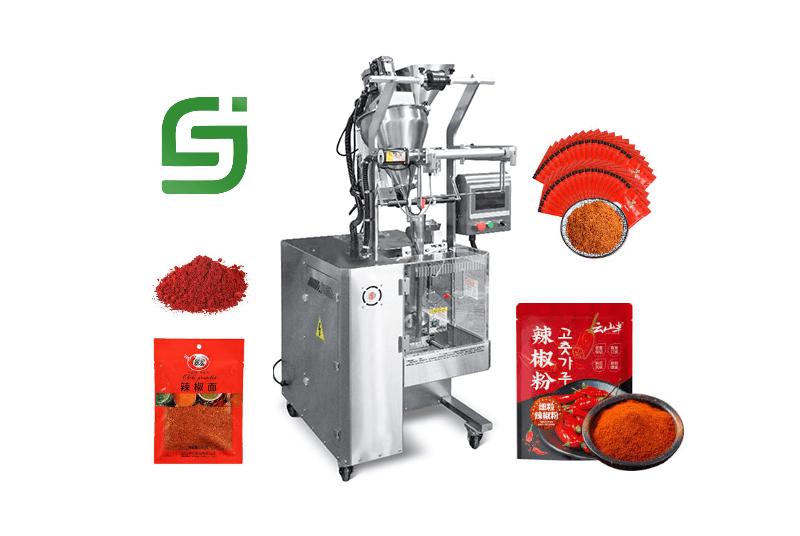
For the target pack, collect individual sachets after warm-up, during stable operation, around a refill, at low level and after a routine stop. Report mean, spread, giveaway and rejects for each phase. If the buyer requires a small dose near 1 g, agree the measurement resolution and tolerance before testing; the nominal stored range alone does not establish repeatability.
Dust must be challenged at the transverse seal
Observe whether powder continues to fall after the screw stops and whether air movement carries fines onto the web. Open seals from a sustained run, looking for red dust, wrinkles, channels and incomplete fusion. Include a normal pause and restart because settled powder can release late. Record the wipe or extraction intervention needed to maintain the accepted result.
The bag drawing governs former, film and coding choices
Approve finished length and width, seal margins, headspace, print repeat, eye mark, roll direction, tear feature and code area. The stored page lists back, three-side and four-side seals; the quotation must identify the format and tooling selected for this machine. Run the production laminate because heat response and powder adhesion can differ from a generic demonstration web.
Retain the chili lot, grind information and room-conditioning record.
Keep phase-labelled individual weights and the selected screw settings.
Retain opened seals from sustained dusty operation and after restart.
Photograph contact surfaces before release and record removed parts.
Accepted output deducts every weight and seal failure
The 30-60 bags-per-minute field is a planning range. During FAT, report the set cycle rate, actual discharge count and accepted count. Separate rejects for weight, dusty seal, registration, cut and coding. A lower setting that holds the agreed dose and clean seal may deliver more usable sachets than a faster run requiring frequent stoppage.
Cleaning must control both residue and operator exposure
Map the hopper, screw, outlet, forming area, seal guards and collection ledges. Define safe emptying and a method that does not spread chili dust through the room or drive it into bearings and electrical enclosures. After reassembly, verify fasteners, guarding, screw rotation, empty operation and the first released sachets before normal production resumes.
Handover records should make repeat production possible
Keep the powder lot, screw identification, recipe values, film specification, former, seal temperatures, weight data, reject log and cleaned-machine photographs together. Add operator instructions for loading, refill level, pause response and exposure control. The file should distinguish fixed mechanical parts from editable screen settings so a later shift does not try to correct a hardware mismatch with software values.
Questions to settle before buying a chili powder line
Are both screw arrangements included?
Not automatically. The delivered feed and dosing hardware must be named in the quotation.
Does the 1 g lower range prove accuracy at 1 g?
No. The actual chili, screw and measurement method must demonstrate repeatability.
Why test powder after room exposure?
Moisture and oil can change clumping, flow and residue compared with a fresh sample.
How is dust-related seal failure found?
Open packs produced during a sustained run and after a routine restart.
What speed should be accepted?
Use the sustained count of sachets that pass weight, seal, registration, cut and code checks.
Conclusion
The YS-61F should be released against a named chili grade, identified screw arrangement, phase-separated weight study, dust-exposed seal inspection and controlled cleaning method. The powder packing machine category remains the relevant product path, while the accepted result stays specific to the tested material and package.


 Tel: +8617350750975
 Email: info@vffspackingmachinery.com
 MP/WhatsApp: +8617350750975
 Manufacturer Address:Meixi Road, Tongan District, Xiamen,Fujian,China



"Uses less energy than expected. Helps keep our operational costs down without sacrificing performance2024-08-20
Quiet Operation "Surprisingly quiet during operation. Doesn't disrupt our workspace like other machines we've used."2024-08-20
User-Friendly Interface "The interface is so intuitive; even our new staff learned to operate it within minutes. Saves us a lot of training time!"2024-08-20

Efficient and Reliable "This machine has made our spice packing process incredibly efficient. It's reliable2024-08-20