

Hot Keyword:
Author:YISEN Pouch Packing Machine Manufacturer TIME:2025-02-28
Before contacting suppliers, prepare honey samples from the meaningful ends of your viscosity range, the proposed stick drawing, film data, target fill definition, and the way operators will supply and clean the product. These inputs turn a broad equipment inquiry into a testable selection project.
Choose a honey stick line by proving that it can meter your honey at its real packing temperature, create the intended narrow pack from the approved film, and restart without leaving product in the seal. Machine width or advertised cycle rate alone cannot answer that question. The right configuration is the one whose filler, product supply, web handling, sealing, and cleaning method work together under your normal production conditions.
Honey does not have one fixed flow behavior. Variety, moisture, temperature, filtration, crystals, storage time, and added ingredients can all affect how it moves through a tank, hose, valve, and nozzle. Document the coldest and warmest expected filling conditions, whether crystals or particles can occur, and how long product may remain in the supply system. A sample warmed only for a showroom demonstration may not represent a normal shift.
Also define what happens upstream. State whether honey arrives in pails, drums, or a prepared vessel; how it is transferred; whether gentle warming or agitation is allowed; and how refill affects the product temperature. The machine supplier needs these facts to size the product path and propose a dosing principle. Keep food-process and recipe decisions with qualified personnel rather than asking packaging equipment to correct inconsistent preparation.
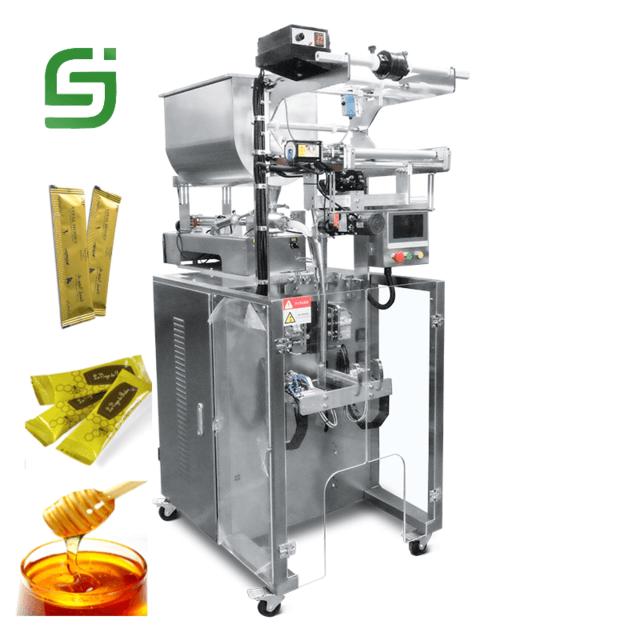
A stick drawing should identify finished width and length, seal widths, cut style, tear feature, print orientation, registration mark, code area, and usable fill space. Narrow packs are sensitive to small changes in web position and product placement. If marketing artwork, nominal fill, and machine geometry are developed separately, the nozzle may have insufficient clearance or the code may land across a seal.
Supply representative film rather than a generic description. The converter should confirm structure, thickness, sealant layer, roll dimensions, unwind direction, core, splice practice, and registration details. Ask the equipment supplier to state the qualified range for the tested construction. A material that forms neatly may still need a different sealing window, and a visually attractive laminate can be difficult to register if the print mark is poorly designed.
The dosing system must move viscous product consistently and stop without a string or delayed drop. Depending on the proposed design, this can involve a pump or piston, heated paths, shutoff nozzles, and synchronized valve timing. Evaluate the complete route rather than a dosing device in isolation. Long hoses, sharp bends, changing tank head, or air entering during refill can affect delivery at the stick.
Accuracy should be assessed from consecutive finished packs at defined conditions. Weighing only a few hand-selected samples can miss drift during warm-up, refill, or restart. Observe whether the nozzle wets the film, whether product is pulled into the transverse seal, and how quickly stable dosing returns after a pause. Record the installed product-contact parts so that the demonstrated result is linked to a reproducible configuration.
Heating, when the process permits it, should make flow manageable without creating uncontrolled hot spots or changing product quality. Define where temperature is measured, which zones are controlled, how operators verify readings, and what happens during a stop. Insulation and safe access matter as much as the heater rating. A warm tank cannot compensate for a cold downstream valve or an exposed nozzle that cools between cycles.
Refill deserves its own trial. Adding cooler honey can change viscosity and tank head, while manual transfer may introduce air. Establish the minimum operating level, refill trigger, transfer method, and settling practice. If recirculation or agitation is proposed, confirm that it is appropriate for the product and does not encourage bubbles. The line should give operators clear actions rather than depending on informal timing.
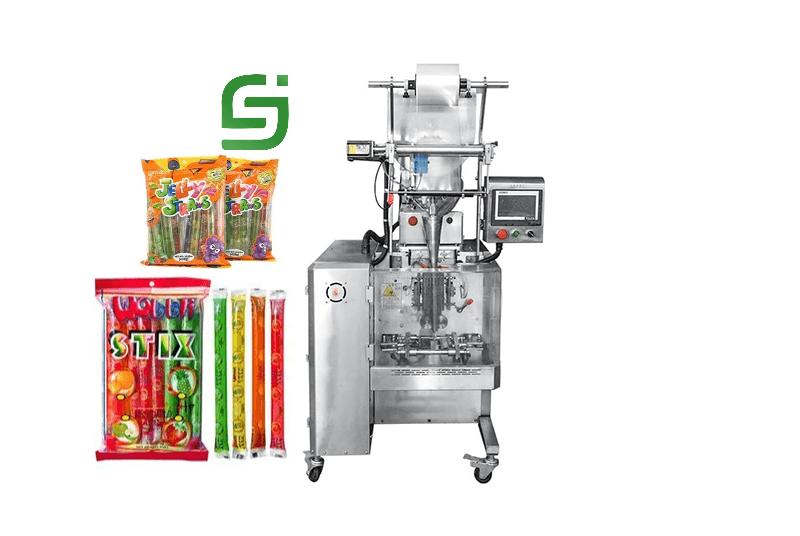
A honey stick fails when product reaches the seal or when the laminate is sealed outside its suitable process window. Review nozzle insertion, cutoff, fill timing, headspace, film support, jaw pressure, temperature sensing, cooling, and discharge as one sequence. Increasing heat is not a sound response to a contaminated seam. First determine whether the pouch mouth arrives clean and flat.
Define how finished packs will be judged. The inspection can include visual seam continuity, code legibility, cut position, weight or quantity checks, and a leak or seal test selected by the site. Examine packs immediately and after expected handling, because a seam can look acceptable before product pressure or flexing exposes a channel. Retain samples with the film roll and test condition identified.
Translate demand into operating windows, not a single daily total. Include shift length, planned cleaning, format changes, film replacement, honey refill, quality checks, and downstream collection or cartoning. A high theoretical rate has limited value if operators must stop frequently to manage product or if finished sticks accumulate at discharge. Determine the accepted output needed during available production time.
Consider staffing and access. Identify who loads film, supplies honey, checks packs, responds to alarms, and cleans contact components. Multi-lane arrangements may increase output but also multiply nozzles, film lanes, seal positions, and samples that must remain controlled. Select the level of automation that the team can run and maintain consistently rather than the largest configuration that fits the floor.
A useful trial starts with documented setup and continues long enough to include realistic events. Use the thickest representative honey condition, approved film, intended stick dimensions, normal refill, a planned pause, and restart. Inspect consecutive packs instead of supplier-selected examples. Open points should identify what was not demonstrated and which evidence is still required.
| Trial moment | What to observe | Decision evidence |
|---|---|---|
| Initial startup | Warm-up, priming, first fills, film registration, seal cleanliness | Time and steps needed to reach accepted packs |
| Steady production | Dose trend, nozzle cutoff, web tracking, code and cut position | Consecutive sample record with reject reasons |
| Honey refill | Temperature change, air, tank level, return to stable filling | Refill procedure and affected sample sequence |
| Stop and restart | Drip, cooling, product in seal, recipe recovery | Approved restart steps and first-off checks |
| End cleaning | Drainage, removal, residue traps, tools and reassembly | Observed cleaning route and release checklist |
Do not turn one successful demonstration into a universal claim. The test establishes evidence for the samples, material, format, and configuration recorded. Products or films outside that scope need separate review or should remain listed as unverified.
Ask suppliers to itemize the filler, product supply equipment, film handling, coding, guarding, discharge, change parts, controls, utilities, documentation, and training. Clarify who approves film and honey samples and what factory and site tests are included. Installation access, electrical standards, air quality, cleaning utilities, and downstream interfaces can change the project even when the core packer looks similar.
The honey stick packaging machine category can help frame liquid and sauce filling options, but the purchase decision must follow the witnessed trial. Compare service access, contact-part identification, recommended spares, recipe management, alarm information, and local troubleshooting capability. A complete scope makes quotations comparable and reduces expensive assumptions at commissioning.
Can the same settings handle every type of honey?
No. Flow and cutoff can change with variety, temperature, crystals, and storage condition. Create approved recipes only after trials with representative samples.
Is more heating always helpful for accurate filling?
No. Heating may improve flow when the product process allows it, but excessive or uneven temperature can affect honey and create inconsistent delivery. Define a controlled product window.
Should machine capacity be selected from nominal cycles?
Use accepted sticks during available production time. Include refill, film changes, inspection, cleaning, planned stops, and downstream handling in the capacity calculation.
Which pack feature is most important to test?
There is no single feature. Dose, clean seals, cut and registration position, code, opening behavior, and resistance to expected handling must all meet the written specification.
What should be retained after a supplier trial?
Keep the configuration list, product and film references, operating conditions, sample sequence, defect log, accepted packs, cleaning observations, and unresolved actions.
Future format plans should be separated into confirmed and possible requirements. A second stick width, different tear feature, or alternative laminate may require tooling and another qualification even if it appears similar. Ask the supplier to identify the conversion parts and operating limits, then postpone performance claims until representative material is available. This keeps the initial purchase realistic while leaving a controlled route for expansion.
Keep accepted samples beside the approved setup record for later comparison.
A sound honey stick selection begins with real viscosity conditions and a finished-pack drawing, then connects dosing, heat management, web control, sealing, and cleaning through a witnessed trial. Choose the configuration that repeats accepted packs through startup, refill, stopping, and restart. That evidence is more useful than an unsupported rate claim and gives the production team a workable basis for training and acceptance.

YISEN MACHINERY - The ONE-STOP VFFS PACKING MACHINE SOLUTION SUPPLIER
 Tel: +8617350750975
 Email: info@vffspackingmachinery.com
 MP/WhatsApp: +8617350750975
 Manufacturer Address:Meixi Road, Tongan District, Xiamen,Fujian,China