

Hot Keyword:
Author:YISEN Pouch Packing Machine Manufacturer TIME:2025-02-19
The decision should be made with the actual recipe and laminate, not from the word "liquid" alone. A free-flowing drink, an oily dressing, and a sauce containing solids can demand different product paths even when the finished sachets look identical. The useful question is whether a stop-and-go cycle creates enough process margin to produce clean, sealed, correctly dosed packs throughout startup, stable running, brief stops, and restart.
Intermittent motion is a strong choice for liquid sachets when the process needs a calm, repeatable pause for dosing and sealing. Stopping the web during those operations can simplify nozzle positioning, reduce the number of simultaneous movements, and give engineers a clear window in which to control drips, foam, stringing, and seal dwell. It is not automatically the fastest architecture, but it is often the more understandable one for products whose behavior changes with temperature, particles, or viscosity.
In an intermittent form-fill-seal cycle, the packaging web advances, stops, and remains indexed while selected operations take place. That pause lets the nozzle enter or align with a stable opening without chasing a moving target. The machine designer can coordinate dose completion, nozzle shutoff, withdrawal, film movement, and sealing as separate events. For a difficult liquid, that sequence may be easier to observe and tune than several overlapping actions.
The benefit is process separation, not a guarantee of perfect packs. A pause cannot correct an unsuitable pump, a poor cutoff valve, or a sealant layer that is incompatible with the product. It can, however, make cause and effect more visible. If a tail forms after cutoff, the team can change the nozzle timing or suck-back setting and inspect the next indexed group. If the dose splashes, acceleration, nozzle height, and fill profile can be assessed without also changing web speed.
Intermittent movement can also accommodate longer seal contact when the laminate needs it, although heat, pressure, jaw alignment, and cooling still have to be proven together. Buyers should treat available dwell as an adjustable process resource. The correct value comes from a seal study on supplied material, not from maximizing the timer.
A useful sample brief describes what reaches the dosing system after mixing, transfer, holding, and recirculation. Record the expected temperature range, apparent flow behavior, density, entrained air, tendency to foam, oil separation, and any fibers or particles. Note whether the last product in the hopper behaves differently from the first. These observations affect inlet size, valve style, hose routing, agitation, and the way the dose is accelerated and stopped.
Particle information must include shape and deformability as well as nominal size. A soft inclusion may pass a valve that damages a hard inclusion of similar dimensions. Stringy material can bridge an otherwise generous passage. Send representative production material for trials and identify anything that was prepared specially for the test. A smooth substitute proves little about a chunky commercial recipe.
Observe the product after realistic hold time. Viscosity may move with temperature, suspended solids may settle, and foam may accumulate during return flow. The specification should state which conditions the supplier has actually tested and which remain the buyer's operating responsibility.
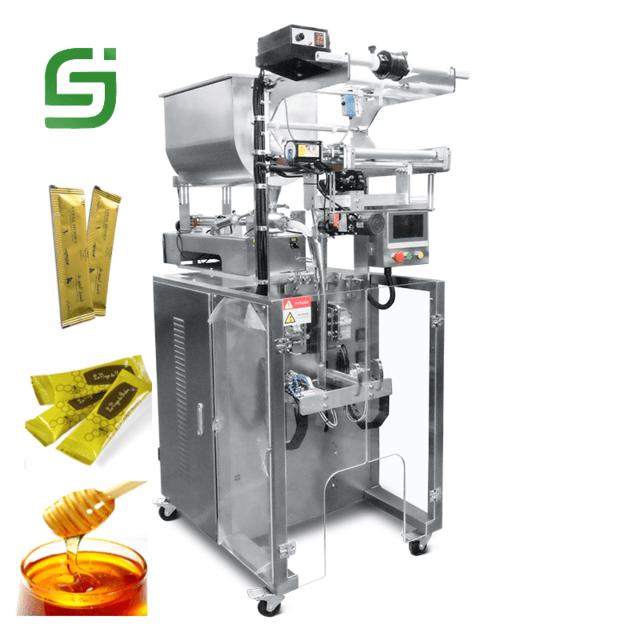
Piston dosing is commonly considered where a defined displacement and decisive cutoff suit the recipe. Pump-based systems can be configured for products that benefit from a controlled transfer profile, while simple gravity or timed-flow arrangements may suit genuinely free-flowing, consistent liquids. These are starting points, not product-name rules. Valve clearances, seals, nozzle bore, refill behavior, and control resolution matter as much as the broad filler label.
Judge the complete dose curve. The inlet stage must refill reliably; the delivery stage must avoid an abrupt impact that creates splash; the final stage must stop without a thread crossing the seal. A two-stage or shaped fill profile may be useful, but only a recorded trial can show whether it improves the actual pack. Weigh filled samples across startup, normal running, low supply level, and restart rather than presenting one favorable group.
The product supply system belongs in the review. Head pressure changes, pump pulsation, air pockets, and long flexible hoses can alter dosing even when the filler itself repeats its command. Define the battery limits between the upstream vessel and the machine so utilities, level control, recirculation, and return paths do not become late surprises.
Liquid packaging problems often become seal problems. The first defense is spatial: maintain enough distance between the top of the dose and the closing seal, control sachet opening, and prevent the nozzle from wiping product onto the film. The second defense is temporal: allow drips or foam to settle before the seal area enters the jaws. Intermittent sequencing gives the controls engineer distinct points at which to manage those events.
Seal evaluation should go beyond appearance. Agree on a leak or integrity method suitable for the pack, inspect channels and wrinkles, and condition samples before destructive checks when the material requires it. Separate contamination failures from temperature or pressure failures. Increasing heat may disguise neither a wet interface nor a distorted jaw.
Challenge the line with the conditions most likely to soil the seal: the highest intended fill, a foaming batch, inclusions near the allowed limit, and a restart after product has remained in the nozzle. Retain failed packs with the corresponding settings. They are useful evidence for deciding whether the remedy is mechanical, material-related, or procedural.
The package drawing should define width, cutoff length, seal bands, artwork registration, coding area, notch position, and the usable volume below the top seal. Headspace is a functional allowance for filling and sealing, not unused real estate to eliminate casually. A pack that is visually full may provide too little margin for foam, product movement, or jaw closure.
Supply trial rolls from the intended converter and include normal tolerance information. Web curl, coefficient of friction, thickness variation, splice construction, and print-mark quality influence tracking and indexing. Confirm how the machine detects and handles a splice, because a visually acceptable join may not be suitable for forming or sealing.
Evaluate every commercial format that changes forming parts, web width, dose, or seal position. The smallest pack can restrict nozzle clearance; the largest can expose web control or cooling limits. A successful midrange sample does not automatically qualify the ends of the format family.
Continuous motion may be attractive where a stable, free-flowing product and a mature package permit synchronized operations at higher line demand. Intermittent motion may be preferable where fill control, seal dwell, observation, or format flexibility governs the project. The right comparison uses accepted packs over a representative period, including intervention and recovery, rather than theoretical cycles alone.
| Project condition | Why intermittent motion may help | Evidence to request |
|---|---|---|
| Viscous or stringing product | Creates a defined cutoff and nozzle-withdrawal window | Video and samples from startup, steady run, stop, and restart |
| Foam or splash risk | Allows staged dosing and settling before the web moves | Seal-area inspection at the highest approved fill condition |
| Laminate needs process dwell | Separates sealing time from web travel time | Seal study using production film and an agreed integrity check |
| Several sachet formats | Makes individual cycle events easier to retime after changeover | Recorded changeover on the smallest and largest planned packs |
| High output is the main constraint | May require lanes or a different motion concept | Accepted output calculation including stops and rejected packs |
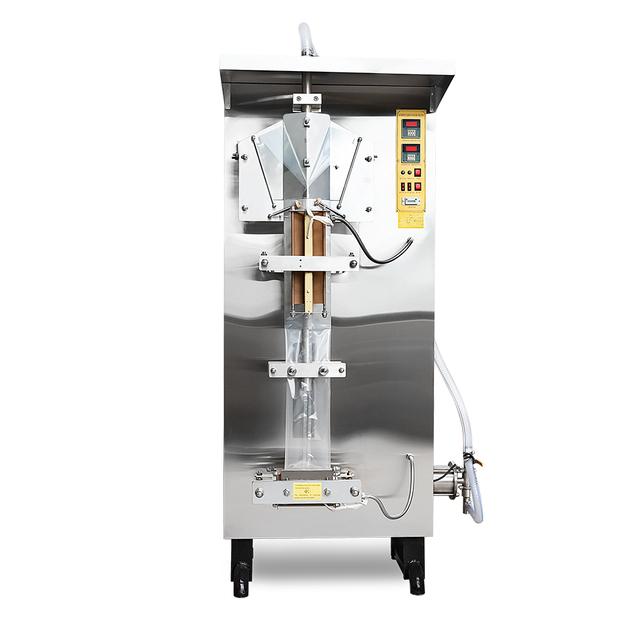
Ask how each product-contact part is drained, removed, inspected, cleaned, dried, and reassembled. Look for retained pockets around valves and fittings, inaccessible hose sections, and product traps below the hopper. The cleaning method must match the plant's approved practice and the ingredients being handled; a supplier description such as "easy clean" is not an operating procedure.
Time a supervised change from the end of saleable production to the first acceptable pack of the next run. Record tools, lifting steps, loose parts, verification points, and product consumed during priming. Then repeat enough of the sequence to reveal assembly mistakes or settings that depend on one technician's memory.
Restart behavior deserves its own sample set. Product left near a warm seal area may thicken, separate, or drip differently. Film can relax while stopped. A controlled restart recipe should define purge handling, initial-pack segregation, checks by the operator, and the point at which output returns to normal release.
Provide the supplier with the recipe range, sample condition, laminate rolls, format drawings, coding requirement, utilities, cleaning boundary, and downstream interface before the trial. Agree how filled quantity, seal integrity, appearance, waste, and interventions will be recorded. State whether adjustments are allowed during the observed run and how they affect the result.
Use a run log with timestamps rather than a tray of selected packs. Count all output generated in the agreed window, classify rejects by reason, and note every stop or manual correction. Keep samples from the beginning, middle, and end, plus packs made immediately after a planned stop. This creates a traceable basis for resolving gaps before shipment.
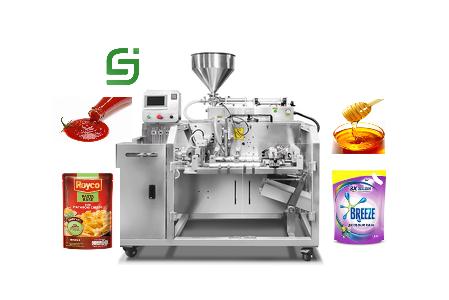
For a broader view of liquid configurations, review the sachet packing machine range only after the application brief is complete. A proposal should identify included dosing hardware, contact materials, format parts, guarding, controls, documentation, and trial commitments. Anything still dependent on future product testing should remain an open item rather than being converted into a promise.
Does intermittent motion always produce better seals?
No. It provides a controllable sealing window, but film compatibility, jaw condition, pressure distribution, temperature, contamination, and cooling determine the result. Test the commercial laminate with the real product.
Is this motion suitable only for thick sauces?
No. Free-flowing beverages, oils, gels, and products with inclusions may all be candidates. The reason to select it must come from the required dose, cutoff, seal, format, and output conditions.
What product sample should be sent for a supplier trial?
Send material that represents normal production and the difficult ends of the approved range. Include temperature, hold-time, and particle information so the supplier does not test an unusually easy sample.
How should usable output be compared?
Count accepted packs during an agreed observation window and record rejects, stops, refills, adjustments, and restarts. A cycle setting without those losses is not a production result.
Which format should be tested first?
Begin with the format that combines the tightest nozzle clearance, highest fill, most demanding seal, or least forgiving material. Then confirm the remaining commercial sizes rather than extrapolating from one pack.
Intermittent sachet equipment earns its place when a stationary process window gives the liquid dose and seal operation useful control margin. Its value is most visible with products that foam, string, splash, carry particles, or leave little tolerance between filling and sealing. That value still depends on suitable dosing hardware, stable supply conditions, approved film, and an operator-ready cleaning routine.
A defensible purchase therefore begins with representative materials and ends with documented packs, rejects, interventions, and restart behavior. When those records show that the indexed cycle handles the full application range, the motion choice is supported by production evidence rather than by a generic machine description.

YISEN MACHINERY - The ONE-STOP VFFS PACKING MACHINE SOLUTION SUPPLIER
 Tel: +8617350750975
 Email: info@vffspackingmachinery.com
 MP/WhatsApp: +8617350750975
 Manufacturer Address:Meixi Road, Tongan District, Xiamen,Fujian,China