

Hot Keyword:
Author:YISEN Pouch Packing Machine Manufacturer TIME:2024-08-20
Yes, a pet food packaging machine can be customized, but useful customization begins with the food, pack, and cleaning process rather than a list of optional components. A supplier should first understand whether the line will handle dry kibble, fragile treats, meat-rich pieces, powder supplements, or several of these products. The correct solution may involve changes to feeding, weighing, product-contact parts, bag handling, controls, and discharge equipment. Buyers get a more reliable result when every requested variation is converted into a sample, drawing, operating condition, and acceptance check.
Some changes are normal format settings, while others require engineering. Adjusting a recipe for a different target weight, changing a bag former within the approved range, or selecting another saved seal temperature may be routine. A different filler, a wider film path, special product-contact geometry, washdown provisions, modified guarding, or communication with an upstream cooker is a project-level change. Treating both groups as "customization" hides cost and risk.
Ask the supplier to classify every request as a standard feature, configurable option, change part, or engineered modification. That classification should appear in the quotation and technical agreement. It tells maintenance staff what can be adjusted on site and what cannot be altered without new hardware. It also prevents a sales phrase such as "supports many products" from being mistaken for approval of every recipe in the factory.
A well-scoped pet food packaging machine should therefore be defined by verified operating windows. The useful question is not whether the platform is customizable in general, but whether the proposed configuration covers the buyer's named products and packs without creating unacceptable breakage, giveaway, residue, or changeover time.
Pet food is not one handling category. Uniform dry kibble may flow freely, while mixed shapes can segregate between a hopper and a weigher. Soft treats may smear or bridge. Freeze-dried pieces can be light and vulnerable to impact. Products with surface oil may leave residue on chutes and interfere with seal cleanliness. Powders used as supplements behave differently again. Each condition changes the feeding and cleaning decision.
Create a product matrix using actual production samples. Record piece dimensions, bulk density, oil or dust tendency, fragility, temperature at packing, inclusion of mixed components, and the acceptable level of product damage. Include the least cooperative batch, not just the best sample. Seasonal formulation changes should also be represented if they materially alter flow.
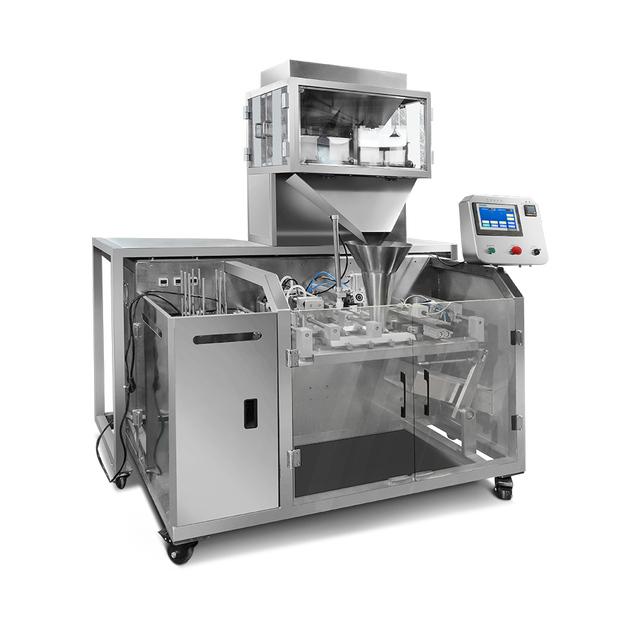
This map makes customization concrete. A low-impact chute may matter for brittle treats; agitation or hopper geometry may matter for bridging product; controlled feed distribution may matter for mixtures that separate. No single option solves every behavior, so the machine design should respond to observed material movement.
The filler is often the most important part of the customized system. Multihead weighing is commonly considered for discrete pieces and combinations, but the number and style of weigh heads, feed surfaces, discharge timing, and transfer height still need testing. Linear weighing can suit simpler granular duties. Volumetric cups may be appropriate where product density is stable and the business accepts their operating principle. Powder products normally call for a different metering approach.
Do not select by nominal speed alone. Review target weight, allowable variation, piece damage, giveaway, refill behavior, and the way the filler recovers after a stop. A machine may produce acceptable packs at steady state yet lose control while the hopper is refilling. The interface between feeder and packer must keep the product supply stable without overloading the dosing system.
If several products share one line, request separate trial results and recipes. The physical change parts, cleaning steps, and operator checks should be stated for each family. A recipe can store settings, but it cannot compensate for a feeder that is fundamentally unsuitable for a sticky or fragile product.
Customization for package variety must go beyond nominal fill weight. Record flat bag width, finished length, usable seal area, film structure, thickness range, print registration, opening or zipper requirements, and the way the filled bag will be cased. A small treat pouch and a large kibble bag impose different demands on forming, pulling, sealing, support, and discharge even when both are made on a vertical platform.
Use approved packaging samples during design review. The supplier can then confirm forming hardware, sealing jaw pattern, film tracking, coding position, and whether a bag support or settling step is needed. For printed film, artwork position and eye-mark contrast should be checked rather than assumed. For oily products, the process must keep the seal zone clean; extra heat does not correct product trapped in the seal.
| Customization decision | Evidence to provide | Acceptance focus |
|---|---|---|
| Product feeding | Representative samples and handling notes | Stable flow without harmful breakage or segregation |
| Weight range | Target weights and permitted variation | Repeatable results at start, steady run, and refill |
| Bag formats | Dimensioned samples and film specifications | Forming, appearance, seal integrity, and discharge |
| Changeover | Product sequence and sanitation method | Accessible cleaning and documented restart checks |
| Line connection | Upstream and downstream interface details | Controlled product supply and clear fault handling |
Customization should reduce the places where product can collect. Inspect hopper corners, weigh buckets, transfer chutes, forming tubes, guards, and frames beneath the product path. Removable contact parts can simplify cleaning only if operators can remove and reinstall them safely and consistently. Tool requirements, part weight, drying, inspection, and storage all influence the real changeover time.
Where allergen separation or recipe control is important, agree on a cleaning method with the buyer's quality team. The packaging-machine supplier can design access and materials, but the food producer remains responsible for validating its sanitation procedure. Avoid vague promises that a construction style is automatically suitable for a particular hygiene standard. The requirement should be written in terms of surfaces, access, drainage where relevant, and the buyer's verification process.
Consider the order in which products are packed. A practical campaign sequence may reduce difficult cleanouts. Product-contact parts dedicated to a sensitive recipe can sometimes be more manageable than frequent deep cleaning, but labeling and storage controls are then necessary.
Controls customization is valuable when it makes the approved process easier to repeat. Useful recipe fields may cover target weight, feeder behavior, bag length, registration settings, seal parameters, and timing between filler and bagger. Access levels can prevent casual changes to quality-critical values. The screen should present actionable alarms in language operators understand, rather than only showing component codes.
Interfaces also deserve a written sequence. Define what happens when the downstream conveyor stops, the coder reports a fault, film runs low, or the filler lacks product. Decide whether the line pauses, finishes the current bag, rejects a pack, or waits for operator confirmation. These details affect product loss and restart quality.
Data requests should be proportional to the operation. Batch records, production counts, or communication with a plant system may be useful, but only when fields, ownership, and test methods are clear. Adding an undefined "Industry 4.0" option does not by itself improve packaging control.
A customization proposal becomes credible when it is tested with production-representative product and film. The trial plan should include the smallest and largest target packs, the product most likely to bridge or break, and any demanding printed material. Agree beforehand how many consecutive packs will be inspected and which observations matter: weight distribution, product damage, seal contamination, bag appearance, coding, alarms, and recovery after a stop.
Record machine settings and ambient conditions with the results. If a trial uses substitute film or a different recipe, mark the limitation and schedule a follow-up test. Samples should be retained where practical so the accepted appearance is not reduced to a verbal memory.
Changeover should be demonstrated as part of the evidence. Operators need to see which components move, how references are set, what must be cleaned, and which first-off checks release the next run. A successful steady run alone does not prove that a multi-format line will be manageable in daily production.
Customization adds value when it removes a defined constraint or protects a required pack result. It also adds parts, documentation, training, and future support obligations. Rank requests as essential for launch, valuable for a confirmed near-term product, or speculative. This keeps the project focused and can reserve physical or electrical space for future additions without purchasing every feature immediately.
Review ownership of change parts and spares before ordering. Format sets should be identifiable, stored, and linked to instructions. Unique engineered components need drawings or part references and a realistic replacement route. Maintenance staff should know which adjustments are approved and which could disturb alignment or safety.
The final scope should state excluded products and pack sizes as clearly as included ones. A boundary is not a weakness; it is what makes performance testable. When later demand falls outside that boundary, the buyer can evaluate a controlled modification instead of discovering the limitation during production.
Can one machine pack both kibble and pet treats?
Possibly, when both products can use compatible feeding, weighing, bag-making, and cleaning arrangements. Trials should check breakage, residue, and the physical changeover rather than relying on the product names alone.
Does a touchscreen recipe eliminate mechanical change parts?
No. Recipes restore control values, but bag width, forming geometry, filler components, or guides may still require physical parts and verified setup references.
Can a future package size be added after installation?
It may be possible within the platform's mechanical and control limits. Ask the supplier to document reserved capacity and the items that would need review before promising future compatibility.
Should every product be tested before the purchase order?
Test the products that represent the operating extremes. Similar low-risk variants may be grouped only when their relevant flow, fragility, density, and pack conditions are genuinely comparable.
Who approves the sanitation procedure?
The machine supplier should provide cleanable access and maintenance guidance, while the food producer's quality team validates the actual procedure for its products and site requirements.
Pet food packaging equipment is customizable when the project translates product behavior and commercial pack needs into measurable engineering requirements. Start with representative samples, define the dosing and bag ranges, make sanitation and line interfaces explicit, and test the demanding combinations. The strongest purchase specification does not ask for unlimited flexibility. It identifies a useful operating window, documents how formats change, and leaves evidence for operators and maintenance teams to reproduce the approved result.

YISEN MACHINERY - The ONE-STOP VFFS PACKING MACHINE SOLUTION SUPPLIER
 Tel: +8617350750975
 Email: info@vffspackingmachinery.com
 MP/WhatsApp: +8617350750975
 Manufacturer Address:Meixi Road, Tongan District, Xiamen,Fujian,China