

Hot Keyword:
Author:YISEN Pouch Packing Machine Manufacturer TIME:2024-08-20
A reliable material change therefore combines package engineering with machine setup. The film or premade pouch must protect the sauce, run through the transport system without distortion, seal within a stable process window, and survive distribution. Samples from the intended converter are more useful than a broad material name on a quotation.
Yes, a ketchup packing machine can work with several packaging materials, but compatibility must be proven for each complete laminate and pack size. The machine does not seal generic “plastic.” It handles a material with a specific thickness, stiffness, friction, barrier structure, print registration, and inner sealant layer while ketchup is filled at a defined temperature and viscosity.
Statements such as “supports laminated film” are too broad for a purchasing decision. A laminate is a combination of layers selected for printing, mechanical strength, barrier, and sealing. Even two structures with similar layer names may run differently because gauges, adhesives, surface treatments, slip additives, and sealant formulations vary. Premade pouches add tolerances for the mouth, zipper, gusset, and cut profile.
Start with a controlled packaging specification. Record the supplier, material code, layer construction, total thickness tolerance, roll width or pouch dimensions, unwind direction, artwork repeat, eye-mark position, seal area, and storage conditions. Mark which alternatives are approved and whether substitutions require a new trial. This document prevents an operator from treating visually similar materials as interchangeable.
The machine builder should state the tested structure, not merely the family. If a recyclable or reduced-gauge option is being considered, treat it as a new engineering case until forming, tracking, sealing, appearance, and package integrity have been confirmed.
Material performance cannot be separated from the sauce. Ketchup viscosity changes with formulation and temperature, and some products contain visible herb or vegetable particles. The fill temperature affects flow through the pump and nozzle and can transfer heat to the seal area. A string of product at nozzle cutoff may contaminate the pouch mouth even when the film itself seals well under clean laboratory conditions.
Describe the normal and difficult product conditions: temperature range at the filler, apparent viscosity or an agreed flow test, particle size, tendency to foam, and time the sauce may remain in the hopper during a stop. Note cleaning chemicals and contact times because they influence the material choices for product-contact components, although they do not determine the package laminate.
Filling control should minimize dripping, splashing, and product tails. Nozzle design, suck-back behavior, fill profile, and the distance to the pouch opening all matter. A laminate trial that ignores mouth contamination gives an incomplete answer to compatibility.
The outer layer typically carries print and contributes stiffness, scuff resistance, and heat resistance. Intermediate layers may add mechanical strength or barrier. The inner layer contacts the product and must form the seal under the machine's time, temperature, pressure, and cooling conditions. The package designer selects the barrier based on the sauce, intended shelf life, light or oxygen sensitivity, and distribution environment.
Common commercial structures may combine polyester, polyamide, polypropylene, polyethylene, foil, or barrier coatings, but their presence does not guarantee suitability. Foil can provide strong barrier performance but changes stiffness, crease behavior, and metal detection considerations. Transparent structures allow product visibility but still need a validated barrier. Mono-material-oriented designs may support a packaging strategy while presenting a different sealing window or stiffness from the previous laminate.
Do not copy a competitor's material description without understanding the product and market. Package compliance, food-contact declarations, migration requirements, and labeling are responsibilities to confirm with qualified material suppliers and the buyer's regulatory team.
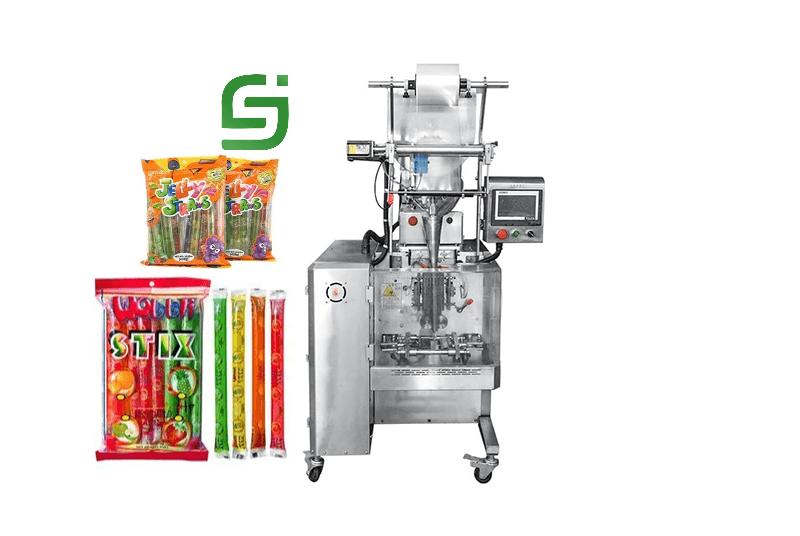
On rollstock equipment, a material change can affect unwind tension, edge guiding, forming resistance, pull-belt traction, print-mark sensing, cut position, static behavior, and seal settings. On premade-pouch equipment, pickup reliability, opening, gripper position, zipper separation, pouch presentation, and top-seal cooling may need attention. Recipes can store repeatable values, but they cannot correct a laminate that lies outside the hardware's practical range.
Ask whether different seal-jaw surfaces, heaters, cooling features, forming parts, vacuum cups, or gripper adjustments are required. List these items in the changeover instruction. The operator should know which settings are allowed, which components must be fitted, and which observations trigger a stop for quality review.
Printed material also needs a sensor trial. Contrast, eye-mark size, background artwork, reflective layers, and web movement influence registration. Coding should be checked for adhesion and readability on the actual print surface without damaging the laminate.
A single attractive pouch made at one temperature does not prove a robust process. Trial several combinations within the proposed time, pressure, and temperature ranges, then identify a central region that produces acceptable seals. The operating recipe should not sit at the edge where a small change in speed, room condition, jaw temperature, or material gauge causes failure.
Inspect clean seals and deliberately challenging samples with a controlled amount of sauce near the mouth. Use test methods appropriate to the package, such as visual examination, peel assessment, leak detection, compression, or distribution simulation. Define the acceptance criteria before testing. Seal appearance alone can miss channels or weak areas, while an excessively aggressive condition may distort the pack or damage printed layers.
Cooling and downstream handling are part of the result. A hot seal can be weakened if the filled pouch is bent, squeezed, or stacked too soon. Observe the path from the jaws to the takeaway conveyor and collection point.
Narrow sachets, pillow pouches, stand-up pouches, and zipper bags do not place the same load on a laminate. Small sachets need precise tracking and clean cross seals around a limited opening. A stand-up pouch must open reliably, accommodate product volume in its gusset, remain controlled in the grippers, and close across a wider top. A zipper introduces extra layers and a step in the sealing region.
Headspace, filled thickness, corner geometry, tear notches, and the location of coding should be shown on the approved drawing. If several sizes are planned, do not validate only the middle format. The smallest may be sensitive to registration and product contamination, while the largest carries more load and may need greater support after sealing.
The chosen sauce packaging machine should have a written format matrix connecting each package code to its approved material, change parts, recipe, fill condition, and inspection plan. That matrix is more actionable than a promise of broad flexibility.
| Candidate change | Primary production questions | Required proof |
|---|---|---|
| Different supplier, similar construction | Are gauge, friction, stiffness, sealant, and print response equivalent? | Incoming specification review plus a full machine trial |
| Thinner laminate | Will it track, form, resist wrinkling, and protect the filled pack? | Run data, seal tests, appearance checks, and distribution samples |
| Foil to transparent barrier | Does the new barrier support the product and declared storage life? | Package-development evidence and packing-line validation |
| Conventional to mono-material-oriented design | Can existing jaws and handling maintain a stable seal window? | Mapped settings across speed and normal material tolerances |
| Plain test film to printed production film | Do registration, coding, surface friction, and appearance remain controlled? | Production artwork roll or pouches tested before approval |
Before the trial, freeze the ketchup batch or product condition, package dimensions, fill target, inspection method, and machine configuration. Use enough material to include startup, stable running, a planned stop, restart, and normal reel or pouch replenishment. Record settings and individual defects rather than only keeping selected good samples.
Evaluate web tracking or pouch pickup, opening, fill cleanliness, code placement, seal integrity, cut quality, finished appearance, waste, and operator interventions. Retain labeled samples from the beginning, middle, and end of the run. If adjustments are made, identify exactly which samples correspond to the final approved settings.
Approval should specify the allowed material code and tolerance, recipe identifier, required change parts, inspection frequency, and response to deviations. When a converter changes a layer, adhesive, treatment, or manufacturing site, the packaging team can then decide whether review or revalidation is necessary.
Can one ketchup line run both foil and transparent laminates?
Potentially, if the handling system and seal jaws can operate within a stable window for both structures. Each exact construction still needs a trial with the intended format and sauce condition.
Does a thicker pouch always seal more reliably?
No. Total thickness is only one variable. Layer design, sealant chemistry, gusset overlap, jaw condition, time, pressure, temperature, and contamination all influence the seal.
Can clear film be used for the factory test?
It can support early setup, but final approval should use printed production material because artwork, surface properties, eye marks, and actual tolerances can change machine behavior.
What usually causes sauce in the top seal?
Likely contributors include nozzle dripping, an unsuitable fill profile, splashing, poor pouch presentation, trapped air movement, or insufficient distance between the fill point and seal area.
Must settings change whenever the laminate supplier changes?
Not automatically, but the replacement must be reviewed against the approved specification. A controlled trial determines whether the existing recipe remains valid.
Ketchup equipment can accommodate more than one packaging material when every alternative is treated as an engineered package rather than a generic film. Define the sauce, laminate, format, handling sequence, and seal acceptance method; then verify a usable process window with production samples. The resulting material-to-recipe matrix gives operators real flexibility without sacrificing package integrity.

YISEN MACHINERY - The ONE-STOP VFFS PACKING MACHINE SOLUTION SUPPLIER
 Tel: +8617350750975
 Email: info@vffspackingmachinery.com
 MP/WhatsApp: +8617350750975
 Manufacturer Address:Meixi Road, Tongan District, Xiamen,Fujian,China