

Hot Keyword:
Author:YISEN Pouch Packing Machine Manufacturer TIME:2026-03-01
Honey packing machines can improve modern production by reducing repeated manual contact, controlling each dose, coordinating clean cutoff with pouch sealing, and making settings and faults more repeatable. Those advantages are not automatic. They depend on a filler that handles the real honey condition, packaging that seals reliably, cleanable product-contact parts, trained operators, and a line sized for actual demand. The investment should be judged through measured product loss, accepted packs, changeover work, sanitation, and quality evidence.
Manual honey filling can involve scooping, pouring, wiping, positioning packages, and judging fill by eye. A machine creates a defined route from supply through metering to the package. This can reduce repeated open handling and place operators in monitoring, replenishment, sampling, and changeover roles.
Automation does not remove the need for people. Operators still verify product, load film or pouches, respond to faults, inspect output, and clean. The advantage is a consistent sequence with guarded motion and controlled access when the equipment, procedures, and training are appropriate.
Assess ergonomics during layout. Honey containers, film rolls, pouch stacks, filler parts, and cleaning assemblies need safe handling. A poor loading height or heavy removable component can move strain from one task to another.
Piston or suitable pump-based filling can repeat controlled product movement when honey condition and supply remain stable. The target should sit inside the filler's useful range. Ordered package measurements reveal average, variation, and drift through startup and hopper refill.
Honey viscosity changes with product type, temperature, crystallization, and residence. Calibration should use representative product at the producer's approved condition. Air in the line, changing product head, valve leakage, or partial blockage can disturb results; increasing the dose does not correct those causes.
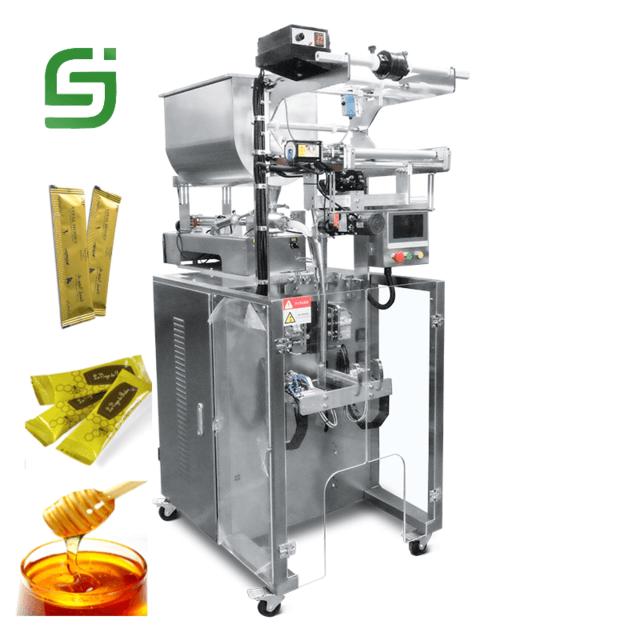
A honey packing machine can reduce overfill and underfill only when measurement and adjustment are controlled. The producer remains responsible for its legal and internal net-content program, verified scales, sampling, and disposition of nonconforming packs.
Sticky honey can trail from the nozzle after the main dose. A suitable shutoff valve, nozzle geometry, and restrained suck-back where appropriate can make cutoff more predictable. Nozzle entry, withdrawal, distance, and pouch support keep the product stream inside the package.
The benefit appears as cleaner pouch tops, less residue on machine surfaces, and fewer sealing interruptions. It must be demonstrated at automatic cycle conditions. A short hand-triggered dose may not show what happens after continuous filling, a stop, or a change in product level.
When cutoff degrades, inspect honey condition, pressure, air, valve and seal wear, nozzle cleanliness, and timing. Aggressive reverse movement can introduce air or affect the next dose. The approved setting balances separation and metering stability.
Rollstock equipment can produce repeated bag lengths, registration, seals, and cuts within its qualified material and setup. Premade-pouch equipment can repeat pickup, opening, filling, top alignment, and sealing for approved pouches. Both routes can create consistent shelf presentation when material and process remain controlled.
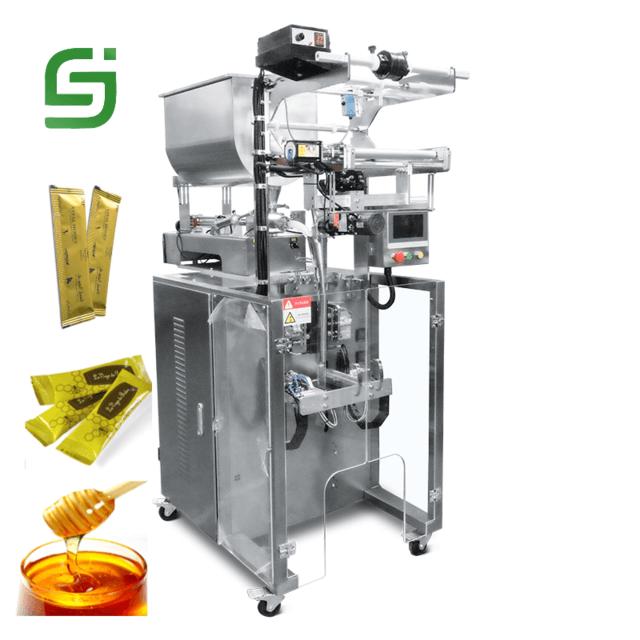
Honey must remain below the closing area. Fill cutoff, headspace, nozzle alignment, and package movement protect clean film. Sealing heat, pressure, and dwell are then established for the intended laminate. Raising temperature is not a dependable response to honey trapped in the interface.
Finished packs should be inspected after realistic discharge and handling. The product owner validates barrier, seal integrity, opening, shelf life, and distribution. The machine contributes repeatability but does not replace package qualification.
A closed and accessible route can reduce uncontrolled contact, provided hopper, pump or cylinder, valves, hoses, joints, and nozzles are designed for the intended cleaning method. Low-retention geometry and removable parts can shorten difficult access. Materials and seals must suit honey, operating condition, and cleaning agents.
The producer's quality team defines sanitation, recovery of residual product, inspection, and release. Automation improves traceability when cleaning steps, part identity, reassembly, and first-off checks are recorded. It does not make every internal surface clean simply because the exterior is stainless steel.
| Potential advantage | Condition required | Evidence to track |
|---|---|---|
| Less manual contact | Controlled supply, guarded filling, and trained work | Operator tasks and open-product interventions |
| More consistent quantity | Stable honey condition, correct filler, and calibration | Ordered measurements, giveaway, and refill response |
| Cleaner package tops | Decisive cutoff, alignment, headspace, and support | Drip observations and seal-contamination rejects |
| Repeatable sanitation | Accessible route and validated cleaning procedure | Change records, inspection, and approved restart |
| Higher useful output | Balanced filling, packaging, replenishment, and discharge | Accepted packs over a representative period |
Automation can store dose, timing, nozzle movement, bag length, registration, seal values, and station timing as recipes. Physical parts may still change for another dose range, pouch width, nozzle, former, or guide. Clear recipes reduce memory-based setup only when they are linked to correct hardware.
Honey varieties and flavored products can differ in flow and cleaning risk. Format additions should be reviewed with samples and drawings. A future pouch that falls inside a quoted dimension range may still conflict with zipper position, filling clearance, or filled weight.
Measure complete changeover from last accepted old pack to first accepted new pack, including product recovery, cleaning, parts, material, recipe, priming, and quality release. This shows whether flexibility supports the production schedule or merely adds options.
Useful controls identify low product, missing or unopened pouch, film end, registration problem, abnormal seal temperature, guard state, and downstream stop according to the system. The alarm should explain the affected area and the operating procedure should define package disposition.
Counts and fault history can expose recurring pouch-opening losses, refill-related quantity drift, nozzle cleaning needs, or seal interruptions. Records need consistent cause coding; otherwise a large "operator stop" category provides little improvement value.
Access levels protect critical recipes. Authorized adjustments should record reason and verification. Data supports decisions, but trained observation remains essential for sticky product, package condition, and sanitation.
Build the case from required accepted packs, current labor tasks, product giveaway, packaging rejects, cleaning time, changeover, maintenance, utilities, floor space, and market package needs. Do not assume a universal payback or output. Costs and benefits vary by plant, product, and package.
During supplier trials, use representative honey and intended material. Include startup, refill, continuous running, stop, restart, and cleanup. Record quantity, drips, seal contamination, packaging waste, interventions, and accepted output. Note manual supply or substitute film that could make the demonstration easier than the factory process.
Consider support, training, documentation, spare parts, and internal technical capacity. Automation delivers lasting value when the factory can operate, clean, troubleshoot, and maintain the line rather than depend on permanent specialist attention.
Compare the proposed process with a clearly measured current baseline. Record who performs filling, wiping, weighing, package handling, cleaning, and rework; how much honey and material are lost; and where quality holds occur. Without that baseline, a general promise of labor saving or waste reduction cannot be tested after installation.
Separate benefits that affect capacity from those that protect quality. Cleaner cutoff may reduce seal rejects even if gross cycle rate remains unchanged. Better recipe control may shorten troubleshooting without changing nominal output. Reduced open handling may support a hygiene objective that is not captured in pieces per minute. Giving each benefit its own measure prevents one optimistic headline from carrying the entire investment case.
Review results after operators have completed training and the line has run representative products. Early commissioning losses should not be hidden, but neither should they be treated as permanent without investigation. Use the same baseline measures to identify improvement, remaining constraints, and any product or pouch that needs another engineering review.
Include maintenance in the value review. Sticky residue, valve and nozzle seals, hoses, heaters where fitted, pouch handling, and sealing tools all need defined checks. A line that raises output but cannot be serviced with available skills and parts may move cost into unplanned downtime. Supplier documentation and local ownership are therefore part of the advantage, not an afterthought.
Use retained acceptable packs and calibration records during periodic review. They help distinguish gradual machine drift from a changed honey batch, pouch lot, or visual expectation.
Will automation prevent every honey drip?
No. A suitable cutoff system can control normal tails, but product condition, valve wear, pressure, air, alignment, and cleaning still require management.
Can one recipe package all honey varieties?
Only products inside a proven behavior range should share settings. Viscosity, crystals, temperature, and additives may require another recipe or hardware.
Does a machine make honey packaging hygienic automatically?
It can provide a controlled, cleanable route. The producer must validate cleaning, handling, inspection, and food-safety procedures.
How should productivity be measured?
Count accepted packages during representative production, including refill, material loading, routine stops, rejects, changeover, and operator work.
What evidence is most important before purchase?
Representative fill measurements, cutoff and seal observations, changeover and cleaning demonstration, accepted output, and documented operating boundaries.
Honey packaging automation creates advantages when it controls the difficult parts of the process: repeatable displacement, sticky cutoff, clean closure, accessible sanitation, and reproducible setup. Buyers should attach each claimed benefit to a condition and a measure. Trials with real honey, commercial packages, routine events, and cleanup then show whether the proposed line will improve production in a durable, supportable way.

YISEN MACHINERY - The ONE-STOP VFFS PACKING MACHINE SOLUTION SUPPLIER
 Tel: +8617350750975
 Email: info@vffspackingmachinery.com
 MP/WhatsApp: +8617350750975
 Manufacturer Address:Meixi Road, Tongan District, Xiamen,Fujian,China